
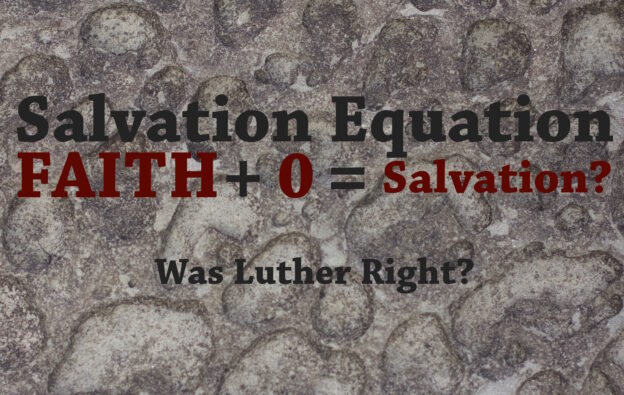
Halloween, is the ironic date the world typically marks as the anniversary of the beginning of the Protestant Reformation that shattered the Roman Universalist Church’s 1,000-year-long spiritual monopoly over Western Christianity. The man who launched that spiritual revolution is the fascinating, but not always loveable Martin Luther.
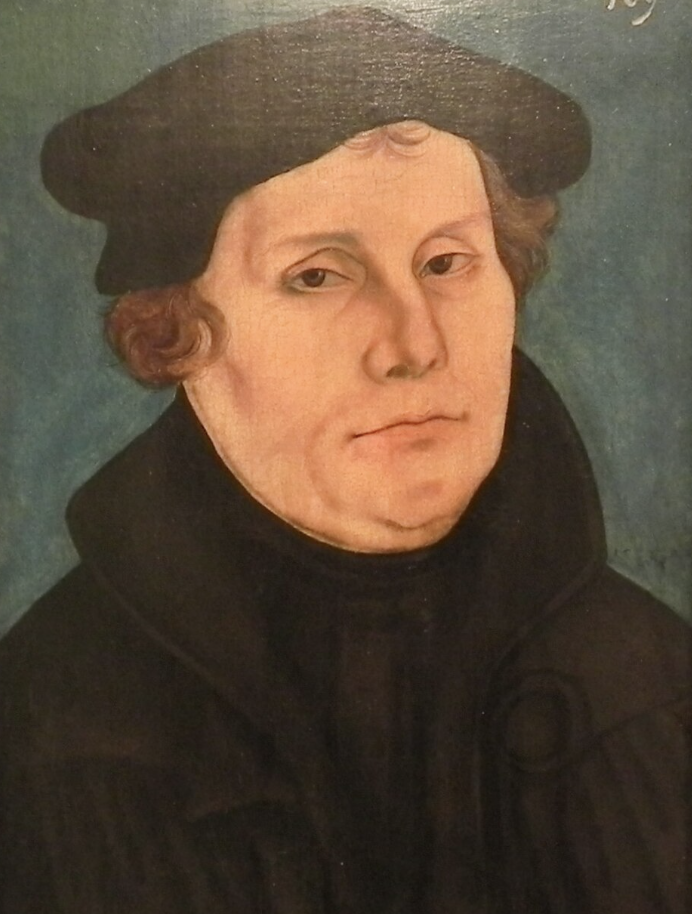
Luther was courageous, intellectually energetic and sometimes even humorous. But he was also pig-headed, argumentative, egotistical, and an infamous anti-Semite. Luther ’s greatest theological legacy to Protestantism is his teaching that justification — being made right before a righteous God — is through faith alone. To Luther, salvation was an open-and-shut case: Believe and you are justified. Once justified you are saved. Once you are saved, you remain saved without any influence of works — good or bad.
Five hundred years on, the painful, unintended consequences of Luther’s justification theology include the failure of the Protestant Church — including most “born-again” evangelical organizations — to make a significant moral and ethical difference in the lives of those attending its worship services. A recent Barna poll found that only 4% of adults in America have a biblical worldview, and among Christians most have adopted a comfortable ‘syncretism’ that opts for an amalgamation of popular societal ideas over the word of God. (from 𝑄𝑢𝑖𝑛𝑛 𝐷𝑒𝑙𝑎𝑚𝑎𝑡𝑒𝑟. 𝑃𝑢𝑏𝑙𝑖𝑠ℎ𝑒𝑑 𝑏𝑦 𝑇ℎ𝑒 𝑊𝑎𝑠ℎ𝑖𝑛𝑔𝑡𝑜𝑛 𝑆𝑡𝑎𝑛𝑑)
The Issue in a Nutshell
Luther began a Reformation and developed His Salvation Equation about five hundred years ago In 1517. At that time, Martin Luther had posted his 95 theses in Wittenberg, decrying some of the abuses within the Catholic church. But it took a few years for him to get to the point of calling the Pope, the “Anti-Christ,” and throwing away the need for the Catholic sacraments. During this time Luther was developing his idea about “justification through faith alone.”
He said he based his understanding on scripture alone, the principal of “sola scriptura.” But did he? Luther had concluded that because we were freely justified (made right with God) through grace, that all we needed was faith. This fit neatly with his background as an Augustinian friar, as it built on Augustine’s idea of predestination. So Luther’s salvation equation was Faith + 0 = Salvation. No “works” were needed.
But was Luther right?
Unintended Consequences
Considering the unintended consequences five hundred years later, we see within the Protestant churches the effects of Luther’s salvation equation. Polls by Barna pollsters over the past decade have concluded that there is little difference between believer and non-believer. Barna reflects on the responses of believers and concludes that their “supposed faith makes little difference in their lives.” Only 15% of the Christians polled were notably different from their secular counterparts in any “good” way. The problem with the faith=salvation equation is that it is missing an essential biblical component. And this lack has produced an ineffective faith, one that does not transform the lives of the believers.
James and his Epistle of Straw
Luther was well aware of James admonition, “Faith without works is dead.” But instead of embracing this truth, Luther rejected it in favour of his own ideas. He called James writings, an epistle of straw.
Martin Luther wrote about James,
“Though this Epistle of St. James was rejected by the ancients, I praise it and hold it a good book, because it sets up no doctrine of men and lays great stress upon God’s law. But to state my own opinion about it . . . I consider that it is not the writing of any apostle.
My reasons are as follows.
First: Flatly against St. Paul and all the rest of Scripture, it ascribes righteousness to works. . . Second, its purpose is to teach Christians, and in all this long teaching it does not once mention the Passion, the Resurrection, or the Spirit of Christ. . . . James does nothing more than drive to the law and its works; and he mixes the two up in such disorderly fashion that it seems to me he must have been some good, pious man, who took some sayings of the apostles’ disciples and threw them thus on paper; or perhaps they were written down by someone else from his preaching. . . . In a word, he wants to guard against those who relied on faith without works, and is unequal to the task . . . and would accomplish by insisting on the Law what the apostles accomplish by inciting men to love.
Therefore, I cannot put him among the chief books, though I would not thereby prevent anyone from putting him where he pleases and estimating him as he pleases; for there are many good sayings in him.”
“In a word, St. John’s Gospel and his first epistle, St. Paul’s epistles, especially Romans, Galatians, and Ephesians, and St. Peter’s first epistle are the books that show you Christ and teach you all that it is necessary and salvatory for you to know, even if you were never to see or hear any other book or doctrine. St. James’ epistle is really an epistle of straw, compared to the others, for it has nothing of the nature of the gospel about it.” 2 Footnotes 1. See Luther’s Works, vol. 35, Word and Sacrament I (Philadelphia: Fortress, 1960), 362.
The Need for a New Equation
James was not alone in his insistence that faith must be accompanied by works. Paul in admonishing the Romans, eloquently writes of the need to obey the law of God. The law has its part to play in making us right with God. He confirms that those who have “died” to sin cannot continue sinning — disregarding God’s law.
John also wrote of the need to put sin (lawlessness) out of our lives so we can live a new life of obedience. Obedience to God, “works,” were to be a proof of our changed lives, and an expression of our faith. So a new equation must begin with the premise that Salvation = Faith in God’s grace + Righteous living (works of obedience) For as James said, “But someone will say, “You have faith, and I have works.” Show me your faith without your works, and I will show you my faith by my works.”
Of course, Luther’s ‘opinion’ on the work of James is in clear contradiction of scripture and history, as James was the half-brother of Jesus, and the leader of the Jerusalem church who lived an exemplary but short life in service to God. And as we have shown his teachings do not contradict those of the other apostolic writers. Luther got the salvation math wrong, and it has had a very negative impact on Christians who think belief does not necessitate obedience.
Paul’s Advice to Timothy about Salvation
But you must continue in the things which you have learned and been assured of, knowing from whom you have learned them, and that from childhood you have known the Holy Scriptures, which are able to make you wise for salvation through faith which is in Christ Jesus.
All Scripture is given by inspiration of God, and is profitable for doctrine, for reproof, for correction, for instruction in righteousness, that the man of God may be complete, thoroughly equipped for every good work. (2 Timothy 3:14-17)
To discover an informed answer as to why this has happened and what can be done about it, see the video about this shocking crisis in contemporary Christianity.
